
Water is leaking right now: what to do before we arrive
Close the main shutoff
Find the main valve where the water line enters the house, usually in the basement near the meter. Turn it clockwise until it stops. A ball valve with a lever closes with a quarter turn.
Cut power near the water
If water is dripping from a ceiling light, soaking an outlet, or pooling near the panel, switch off that circuit at the breaker. Do not stand in water to do it. If the panel itself is wet, stay out and call us and the electric utility.
Open a low faucet to drain the lines
With the main closed, open a tap on the lowest floor to relieve pressure. That slows the leak while you wait.
Contain and document
Move rugs and furniture, set out buckets, and take photos of the damage and the source. Your insurance company will ask for them.
Call the 24/7 line
Dial (603) 815-9179 and describe what you see and where. Same-day appointments are offered when available, and after-hours calls go to the same dispatch.
Smell gas or see sparks?
Leave the building and call 911 and the gas utility first. A water leak is never worth staying in a space with a gas smell or an electrical hazard.
The water meter keeps moving with everything turned off
A meter that creeps forward when every tap, appliance, and ice maker is idle means water is going somewhere. The same goes for a bill that jumped with no change in how your household lives. Both are classic signs of a hidden leak on the house side of the meter.
A running toilet is the most common cause and costs nothing to rule out first. After that, we look at supply lines, the water heater connections, and the buried service line.
A five-minute meter check you can do yourself
Make sure nobody is using water, then read the meter and write down the number. Look for the small triangle or dial that spins when any flow passes through. If it turns with everything off, there is a leak.
Wait 30 minutes without using water and read it again. If the number moved, close the main shutoff and check the meter once more. A meter that stops after you close your main points to a leak inside the house or in the line to it. If it keeps moving with your main closed, the problem may be upstream and the water department should hear about it.
Billing and meter questions
For a billing dispute or a question about your reading, the Methuen Water Department billing line is 978-983-8555. The department can check its side of the meter. We find the leak on yours.
Meter still moving? Ask about a same-day visit when available.
Our licensed plumbers test and locate the leak with instruments, then give you a clear price before any repair starts. Call (603) 815-9179 for a same-day appointment when available.
A brown stain on the ceiling or damp patches on the wall
Water travels. A stain on the dining room ceiling may start at a bathroom drain two feet over, or at a supply line that runs along a joist before it drips. The wet spot is where the water gave up, not where it began.
Ceiling and wall leaks also change fast. A small stain can turn into a sagging, bulging panel within hours, and wet drywall can hold a lot of weight. If the ceiling is bowing, keep everyone out from under it. Any repair that follows a leak find is done to the Massachusetts plumbing code (248 CMR) standards by a licensed plumber.
Stain with a ring that grows
Rings that get darker and wider after a shower or a dishwasher cycle point to a drain or supply line above the stain.
Paint bubbling or peeling
Moisture behind paint pushes it off the surface. It often shows up months before drywall softens.
Musty smell with no visible water
A smell in a closet or room corner can mean a slow wall leak. A moisture meter reads it without cutting anything open.
Sound of running water in a quiet house
Hissing or trickling inside a wall when nothing is on is worth a call. Acoustic gear can pick up that sound at the pipe.
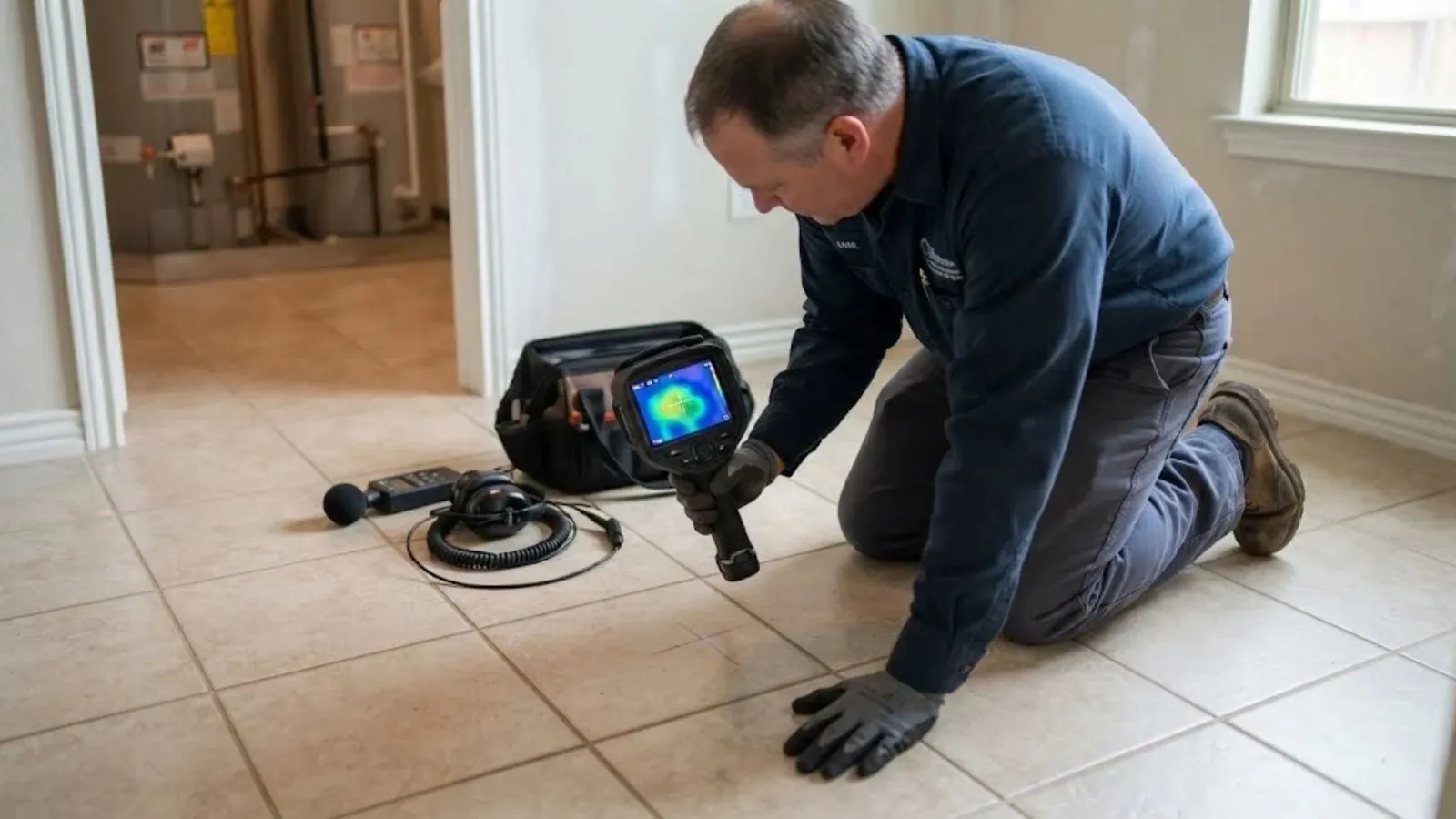
The plumber uses a moisture meter and thermal imaging to map the wet area, then confirm the source before any cutting. Often the opening we need is a small patch you can repaint, not a whole wall.
Damp basement, musty crawlspace, or a floor that feels soft
New England homes sit on basements and crawlspaces, so a lot of plumbing hangs where you can see it, and a lot is hidden behind finished ceilings. That is good news for finding leaks and bad news for ignoring them. A slow drip on a basement supply line can run for months before it shows upstairs.
Look for rust bloom on pipe fittings, white mineral crust on copper joints, drips on the underside of the kitchen or bathroom floor, and wet insulation. In a crawlspace, check for a wet dirt floor under the bathroom, and for a smell that wasn't there last season.
Wet from a leak, or wet from the ground?
Not every wet basement is a plumbing leak. The Methuen DPW reports flash flooding two to three times a year in the Bloody Brook and Jackson Street corridor, and the Spicket River gauge reached 9.86 feet on March 16, 2010 against an 8.0 foot flood stage. In those areas, groundwater after heavy rain can look like a pipe problem.
The test is simple. If the floor is wet only after rain, with the meter standing still, it is groundwater. A (603) 815-9179 call can sort that out, and if it is water coming in, our sump pump repair page covers the next step. If the meter moves during dry weather, you have a leak.
What to look for under the house
- Drips or stains on the underside of the floor above bathrooms and kitchens
- Green or white crust on copper fittings
- Wet or sagging insulation between joists
- Water on the dirt floor of a crawlspace with no recent rain
- Mold smell in a space that was dry last year
Water in the yard or a leak somewhere underground
A buried water service line leaks quietly. There is no stain and no drip, just a meter that runs, or a patch of lawn that stays green, soft, or wet when the rest of the yard is dry. Pressure at the faucets often drops as well. If you have a cold, soggy spot in winter, that can be the line.
The state building code table uses 48 inches as a design frost depth. Many service lines are buried below that, but an older or shallow line can still freeze. The plumber locates the leak by listening along the pipe and marking the spot before any digging. You get a clear price for the repair before work starts. For the repair itself, see our water service line repair page.
Once a leak is located, the repair follows the Massachusetts plumbing code (248 CMR). Ask the plumber how deep the new run will sit and how it will be protected in winter.
Call 811 before anyone digs
Utility lines run underground and a shovel can hit gas or electric. Call 811 first so lines are marked.
How we find leaks without opening the whole wall
Each instrument answers a different question. The plumber starts with the least invasive method that fits your symptoms and may combine two when the first result is unclear. Ask to see where the leak is before anyone makes a cut.
| Method | What it does | Best for |
|---|---|---|
| Acoustic listening | Listening gear and pipe sensors can pick up the sound of water escaping under pressure | Buried service lines, slab and wall leaks |
| Thermal imaging | An infrared camera shows temperature differences from wet material or leaking hot lines | Ceilings, walls, floors, hot water lines |
| Moisture meter | A probe reads how wet drywall, wood, or masonry is | Mapping the size of the wet area |
| Pressure testing | The line is isolated and held under pressure to see if it falls | Confirming a leak exists on a section of pipe |
No method is perfect on its own. Plastic pipe is quiet, noisy neighborhoods mask sound, and very small leaks can be tricky. That is why the plumber may pair methods. When a leak is in a sealed wall or under a finished floor, thermal imaging narrows where the opening has to go.
Slab leaks in Methuen: how likely are they?
A slab leak is a leak in a pipe that runs under or inside a concrete slab floor. Slab leaks are less common in basement homes. Additions, garages and some newer homes may be slab-on-grade.
If yours is slab-on-grade, warm spots on the floor, a hissing sound, or a meter that keeps moving with nothing running deserve a look. The plumber uses listening gear and thermal imaging to look for them, then explains your options.
Yard and meter-box leaks at the curb
Yard and meter-box leaks
Standing water around the meter box can come from a fitting at the meter or from the line just past it. Do not open the box if it is flooded. If the leak is at the curb stop or on the street side, call the Methuen Water Department emergency line at 978-983-8855 for a shutoff there.
Repair now or replace the section: how we decide
Spot repair
- Best when one fitting or one short run of pipe has failed
- Smaller opening and shorter job
- Makes sense when the rest of the pipe is in sound condition
Replace the section
- Best when pipe is corroded in several places or has leaked before
- Costs more now and cuts repeat visits
- Common with old galvanized steel or thin-wall copper
We explain both and you choose. If the leak points to a bigger issue, such as a line that keeps failing, repiping may come up. We will not push it when a repair holds. Related burst or split pipes are covered under burst pipe repair.
What affects the price of leak detection
What affects the price
The cost of finding a leak depends on how hard it is to reach and how many methods the job takes. Repair is separate from detection, and you get a clear price before work starts.
Want your real number? Call (603) 815-9179 and a licensed plumber will talk through your situation.
Landlords, property managers, and tenants
If you manage a rental, a tenant report of a ceiling stain or a high bill should get a same-day look. Water damage grows quickly and so do disputes. We can send a plumber to meet a tenant or lockbox access. Call (603) 815-9179 and mention the unit. We also work with commercial plumbing needs in small buildings.
We serve Methuen and nearby towns such as Lawrence with the same 24/7 emergency dispatch.
Leak detection questions
Yes. Our emergency dispatch runs 24/7, including nights, weekends, and holidays. Call (603) 815-9179, tell us what you see, and we will send a licensed plumber as soon as one is available. Close your main shutoff while you wait.
Check your meter with everything off. If it moves, water is escaping. Other signs are a bill that jumped, stains or bubbling paint, a musty smell, the sound of running water, and warm spots on the floor.
Usually not at first. The plumber uses thermal imaging, a moisture meter, and listening gear to find the spot, then opens the smallest area needed to reach it. Ask to see the location before anything is cut.
Yes. The plumber listens along the line and marks the spot. Call 811 before anyone digs. The state building code table uses 48 inches as a design frost depth. Many service lines sit deep, which makes locating them first worthwhile.
Maybe not. Heavy rain can push groundwater in. The Methuen DPW reports flash flooding two to three times a year along Bloody Brook and Jackson Street. If the meter stands still in dry weather, look at drainage and your sump pump.
The Methuen Water Department billing line is 978-983-8555. We handle leaks on your side of the meter.
Read your water meter, then shut off every fixture and read it again a few minutes later. If the dial moved, write down both readings and tell the dispatcher. Also note any damp spots, stains or sounds so the plumber knows where to start.
Slab leaks are less common in basement homes. Additions, garages and some newer homes may be slab-on-grade. We can check and tell you honestly.
Still not sure what you are seeing? Call (603) 815-9179 and we will help you decide.