
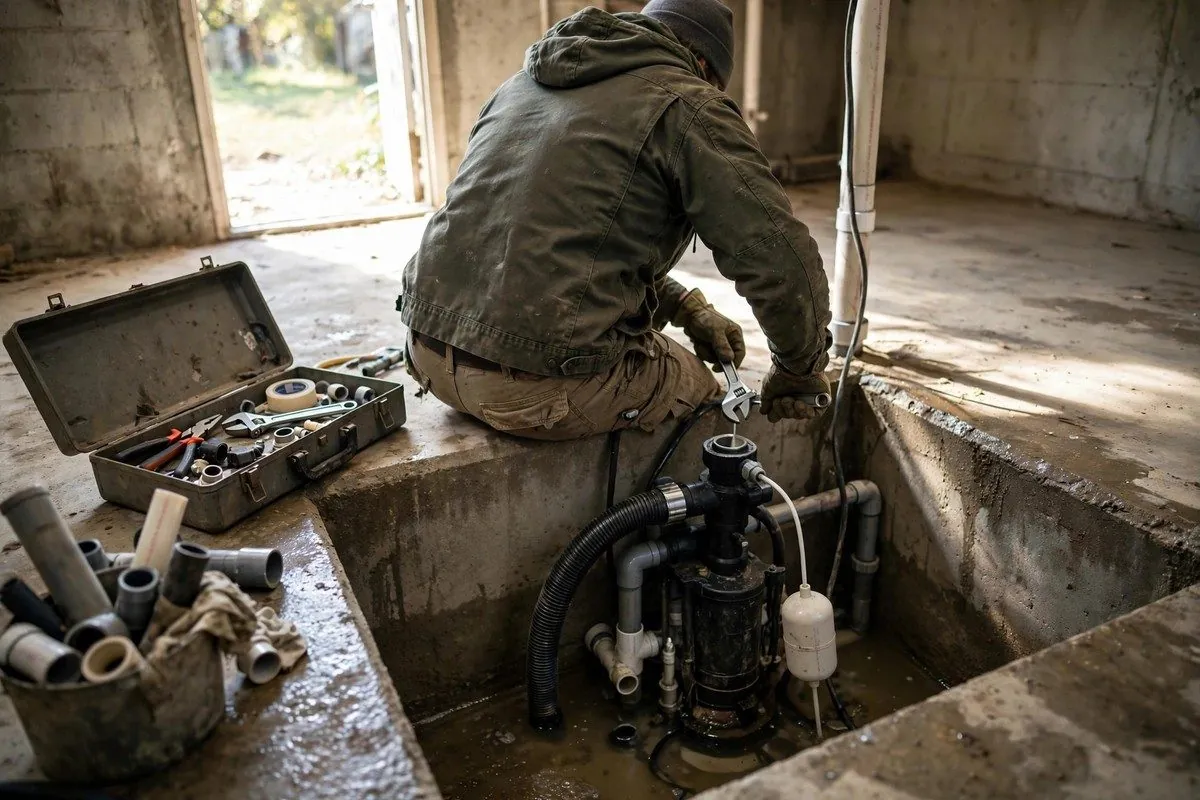
Basement filling right now: stay safe first
Do not wade into the water
Standing water can reach outlets, a furnace, a panel, or a water heater. If water is near any of them, stay out. Electricity and water do not mix.
Stay out of the water
Do not walk through standing water in a basement with electrical equipment.
Cut power only if you can do it dry
If the panel is upstairs or on a dry wall, switch off the basement breakers. If the panel is in the flooded area, leave it alone and call your electric utility.
Check the pump from a safe spot
Look at the pit from the stairs. Is the pump running, silent, or humming without moving water?
Stop adding water
Do not run the washing machine or dishwasher, and keep taps off while water is rising.
Call the 24/7 line
Dial (603) 815-9179. We offer same-day appointments when available and after-hours dispatch for floods.
Why Methuen basements flood and why it matters
The Spicket River gauge at Methuen crested at 9.86 feet on March 16, 2010, against a flood stage of 8.0 feet. Methuen rainfall in that event was 7 to 10 inches. The city also saw major flooding in May 2006.
Closer to daily life, the Methuen DPW reports flash flooding two to three times a year along the Bloody Brook and Jackson Street corridor. If you live near there, or near the river, your pump may run often. A pump that works hard also wears out sooner.
Part of Methuen's sewer system is combined, with five combined sewer overflow outlets in the draft EPA permit, four to the Merrimack and one to the Spicket. In a big storm that load matters, so keeping stormwater out of the sanitary line protects your basement from backing up.
Pump quiet and water rising?
A licensed plumber can come day or night when available and will give you a clear price before work starts. Call (603) 815-9179.
Pump runs but water keeps rising, or the pump will not start
Float switch stuck
The float rides up with the water and turns the pump on. If it snags on the pit wall or its own cord, the pump will not start, or may not shut off.
Failed check valve
The check valve stops pumped water from falling back into the pit. If it fails, the pump short-cycles and wears out. You may hear water slap back after each cycle.
Blocked discharge
A frozen, kinked, or clogged discharge line has nowhere to send water. The pump runs hot and the pit overflows.
Dead motor or power loss
Motors burn out, especially if they ran dry or short-cycled. A tripped breaker or storm power outage stops the pump.
Clogged intake
Silt and gravel at the bottom of the pit can jam the impeller.
We check the power, the float, the check valve, the discharge, and the motor, in that order. Some fixes are quick. Others, such as a worn-out pump, point to replacement.
Test your sump pump before the next storm
Check the power
Confirm the pump is plugged in to a working outlet, ideally a GFCI-protected one.
Look in the pit
Remove debris and make sure the float moves freely.
Add water
Slowly pour a few buckets of water into the pit. The pump should turn on, empty it, and shut off.
Listen and watch
Grinding, rattling, or a pump that runs long with little drop in level means trouble.
Check the outside discharge
Make sure water leaves at the outlet and flows away from the house.
If the pump fails any step, call us. Test it twice a year and before the spring thaw.
Battery backup and water-powered backup
A pump needs power, and storms take power out. A battery backup pump runs on a deep-cycle battery and takes over if the main pump fails or the power goes out. It gives you hours of protection, not days, and the battery needs testing and replacing.
A water-powered backup uses city water pressure to push water out and needs no electricity. It uses a lot of water while running, and some towns restrict it, so ask the Methuen Water Department before installing one.
Battery backup
- Works when the power is out
- Runs for a limited time
- Battery needs regular testing and replacement
Water-powered backup
- No electricity or battery
- Uses city water while it runs
- Needs adequate municipal pressure
Repair or replace the pump
| Situation | Usual answer | Why |
|---|---|---|
| Stuck float or loose connection | Repair | Quick fix and the motor is fine |
| Failed check valve | Repair | Cheap part that protects the pump |
| Pump running constantly or short-cycling | Depends | Could be a valve, a float, or a worn pump |
| Motor burned out or pump is old | Replace | Repair costs approach a new pump |
| Pump too small for the pit | Replace | A bigger pump keeps up in a storm |
Where the water goes: discharge rules of thumb
As general practice, a sump pump should discharge outdoors, away from the foundation, and not into the sanitary sewer. Stormwater in the sewer can overload it, and in a combined system it adds to the overflow problem described above. Rules vary, so ask the building department or the Methuen Inspections Division at 978-983-8625 what is allowed at your address.
Keep the outlet clear of snow and ice in winter, and extend it so water does not run back to the foundation. If you are also dealing with seepage or damp walls, basement waterproofing looks at the cause.
Ejector pumps are different
A sump pump handles groundwater. An ejector pump lifts wastewater from a basement bathroom or laundry up to the sewer line. It sits in a sealed pit and handles solids. If it fails, you may see slow drains or sewage odor. Do not confuse the two. Call us and describe what is in the pit. A wastewater backup also may call for drain cleaning.
What affects the price of sump pump repair
What affects the price
A sump job can be as small as a float or as large as a new pit and backup. You get a clear price before work starts.
Want your real number? Call (603) 815-9179 and a licensed plumber will talk it through.
Landlords and property managers
If a tenant reports water in the basement after a storm, treat it as urgent. Document the damage and call us. We also serve Lawrence and other nearby towns.
Questions we hear
Yes. Emergency dispatch is 24/7, including storms. Call (603) 815-9179, stay out of standing water, and a licensed plumber will respond as soon as available.
Common causes are a stuck float, a failed check valve, a clogged or frozen discharge, a burned-out motor, or a power outage.
At least twice a year and before heavy-rain seasons. Pour water into the pit and make sure it starts and stops.
If your basement floods when the pump stops, a backup is worth considering, especially in flood-prone corridors such as Bloody Brook and Jackson Street.
As a general practice, no. Ask the Methuen building department or Inspections Division what applies at your address.
A sump pump removes groundwater. An ejector pump lifts wastewater from basement fixtures up to the sewer.
The pump may be undersized, the check valve may be failing, or water may be entering faster than it can leave. A plumber can check.
Not sure which case fits yours? Call (603) 815-9179 and describe what you see.