
Why Methuen basements take on water
Methuen sits between two rivers. The Merrimack runs along the south edge, and the Spicket River cuts through the city. The Spicket gauge at Methuen crested at 9.86 feet on March 16, 2010 against a flood stage of 8.0 feet, and Methuen took 7 to 10 inches of rain in the mid-March event, so saturated ground is a real thing here.
The city's public works department also reports flash flooding two to three times a year along the Bloody Brook and Jackson Street corridor, and the city saw major flooding in May 2006. If you live near a brook or low ground, a basement with a drain and a working sump is cheaper than finding out the hard way.
What to do first when the basement is wet
Not every wet basement needs a big project. Gutters, downspouts and grading often cause a surprising share of seepage, so check outside first.
Signs your basement has a water problem
Damp walls or floor after rain
A dark patch at the wall base or a wet slab edge after a storm points to water coming through the wall or up through the floor joint.
White chalky deposits
Efflorescence is mineral left behind when water passes through masonry and dries. It tells you water has been moving through.
Musty smell
A persistent mildew odor suggests moisture, even if you cannot see water.
Standing water at a floor drain
A floor drain that gurgles or fills during a storm may be backing up from the sewer, not leaking from the walls.
A sump pit that never empties
A pump that runs constantly, or is silent while the pit is full, needs attention soon.
Where the water gets in
Water enters a basement in a handful of ways: through the wall, up through the floor-wall joint, through cracks in the slab, through window wells, and back through a drain or sewer connection. Each calls for a different fix.
We check the drainage side. If the entry point is a cracked foundation wall that needs injection or a structural repair, that belongs to a waterproofing or foundation contractor. We tell you which problems are ours and which are not.
Water in the basement this week?
Call (603) 815-9179 and a licensed plumber can check your sump, drain and discharge.
Interior drain tile and sump or exterior membrane
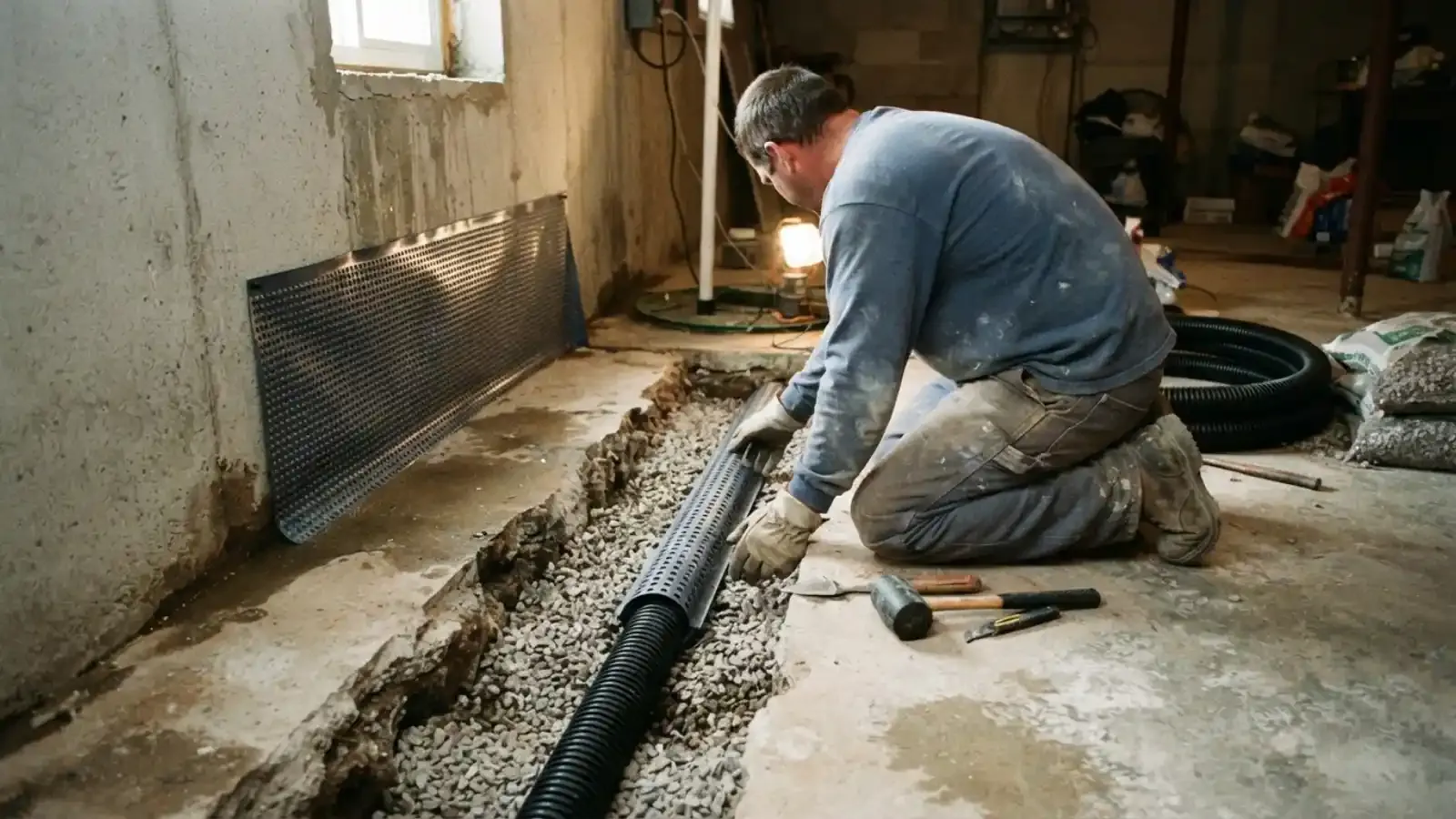
Interior drain tile and sump
- Perimeter drain inside the slab edge leads water to a sump pit
- Pump discharges water outdoors away from the foundation
- Less digging, usually less disruption to landscaping
- Needs electric power or battery backup to work in a storm
Exterior membrane and drain
- Excavate the outside wall, seal it and add a drain at the footing
- Stops water before it reaches the wall
- Heavy digging, high cost and disruption to the yard
- Done by excavation and waterproofing contractors, not plumbers
For many homes, an interior drain with a good sump handles the plumbing side of the problem. Exterior work makes sense in specific cases, and a waterproofing contractor can advise you.
Sump pumps, battery backup and the discharge line
A sump pump sits in a pit and lifts water out of the basement through a discharge pipe. The weak points are the float switch, the check valve and the power supply. A pump that cannot run in a storm is no use, so many homeowners add a battery backup.
The discharge pipe should end well away from the foundation, and it must not freeze solid. A shallow or low-sloped pipe can hold water and freeze in winter. For a buried discharge line, the state building code table uses 48 inches as a design frost depth. For pump problems, see our sump pump repair page.
Sump pumps and battery backups should be installed according to the manufacturer's instructions, and the plumbing side of the work falls under the Massachusetts plumbing code (248 CMR).
Test the pump
Pour a bucket of water into the pit. The pump should start, empty it and shut off.
Check the discharge
Make sure the outlet is clear, points away from the house and is not buried in a drift.
Test the backup
If you have a battery backup, run the self-test as the manufacturer says.
Call if anything fails
A noisy, short-cycling or silent pump should be looked at before the next storm.
Floor drains and sewer backflow
Part of Methuen's sewer system is combined, and the draft EPA permit lists five combined sewer overflow outfalls, four to the Merrimack and one to the Spicket. In a heavy storm, a combined or overloaded sewer can push water back up toward the lowest drain in a house.
A backwater valve on the sewer line helps stop that. It is a plumbing fix we do, and it needs a permit issued to a licensed plumber. A floor drain that backs up during rain is a sewer problem, not a foundation problem, and our sewer line repair team can inspect the line.
Humidity or a leak?
| What you see | Likely cause | First check |
|---|---|---|
| Cold pipes beaded with water in summer | Condensation | Insulate pipes, run a dehumidifier |
| Wet floor only after rain | Groundwater or surface runoff | Gutters, grading, sump |
| Wet floor near the water heater | Tank or valve leak | Check connections, call a plumber |
| Constant dampness near a pipe | Supply or drain leak | Watch the water meter with fixtures off |
What affects basement drainage cost
What affects the price
Scope drives everything here, so we name the factors.
Want your real number? Call (603) 815-9179 and we will take a look.
Questions we hear
No. Crack injection and structural repair are other trades. We handle the plumbing side: drains, sump pumps, discharge and backwater valves.
Ask the Methuen building department and the Inspections Division, and know that plumbing permits are issued to licensed plumbers. A licensed plumber pulls the plumbing permit when one applies.
Look for condensation on cold pipes, check the dryer vent and gutters, and run a dehumidifier. If the dampness persists in one spot, have a plumber check for a leak.
For a limited time. Runtime depends on the battery size and how much water comes in. It is a safety net, not a permanent solution.
Air and water are being pushed through the line. It can be a sign the sewer is overloaded. We can inspect the line and discuss a backwater valve.
Yes. Homes near the river and brooks can see more groundwater, and the plumber can check how the drains and sump handle it.
Have a wet basement right now? Call (603) 815-9179 and a licensed plumber will advise you.