
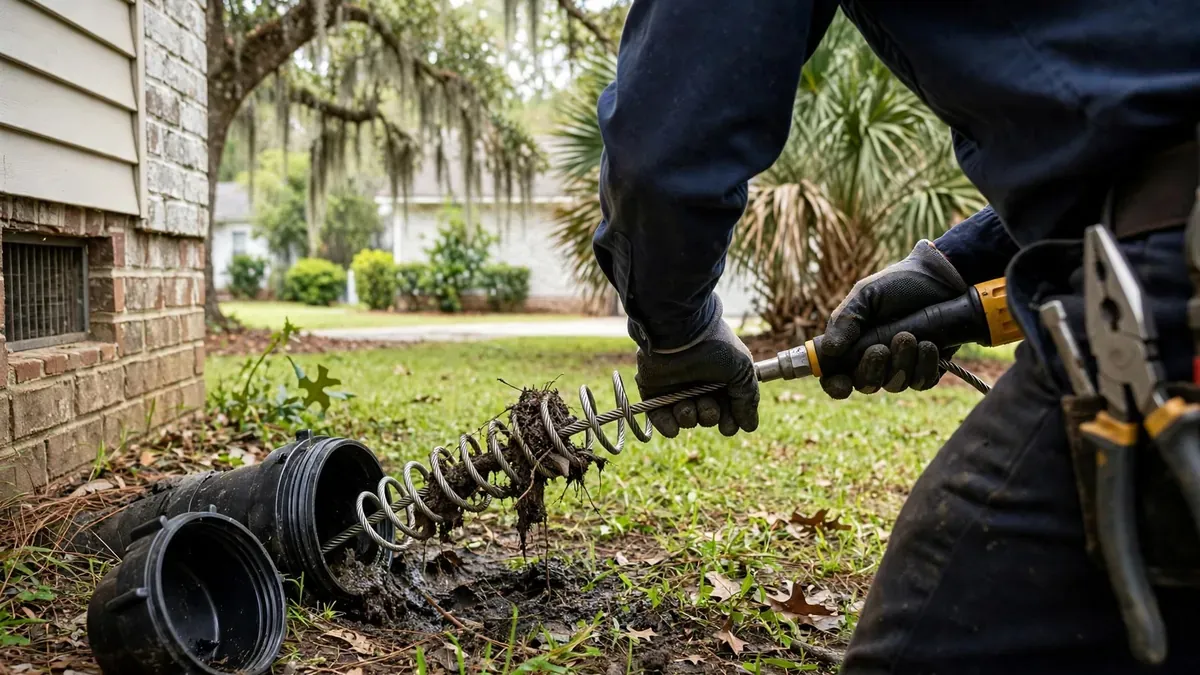
Signs your buried downspout line is blocked
A blocked underground gutter drain shows itself during rain. The gutter overflows over the front edge even though the gutter itself is clean, water gushes out of the downspout elbow at ground level, or a wet patch keeps growing along the foundation.
The quieter signs matter too. A soggy lawn strip running in a straight line from the downspout, a low spot that stays soft for days after a storm, and a gurgling sound inside the pipe all point to a line that no longer drains.
Overflow at the elbow
Water pours from the joint where the downspout meets the buried pipe. The blockage is usually close, often inside the first few feet.
Straight wet strip in the lawn
A line of soft, green, or sunken ground between the house and the street or yard edge can mean a cracked or separated pipe leaking along its run.
Water at the foundation wall
When the line backs up, roof water has nowhere to go but down beside the footing. Check the basement wall below that corner for dampness.
Slow drain after the rain stops
The gutter should empty within a few minutes. If a downspout keeps dripping an hour later, the pipe is partly blocked.
Finding the line before you touch it
Most buried downspout drains are 3 or 4 inch corrugated or smooth plastic pipe, laid with a gentle slope away from the house. Some older systems use clay or cast iron. You cannot clean what you cannot find, so spend ten minutes locating the path first.
Look for a cleanout cap, a round or square cover set flush with the soil near the downspout. Then walk the likely route to the outlet. Check the street curb, a swale, a dry well, or a pop-up emitter in the yard.
How to trace the run
You usually need nothing more than these.
- Mark where each downspout enters the ground with a flag or stake.
- Look at the original plot plan or house plans if you have them.
- Run a hose into the pipe and watch for water at the outlet, or listen at the cleanout.
- Push a flexible tape or a rigid garden hose gently into the opening and note how far it travels.
- Call 811 before you dig anywhere in the yard, because buried utilities share the same soil.
Flush, then cable, then jet
Remove debris at the top
Pull the downspout elbow off the pipe and scoop out the leaves, shingle grit, and mud that collect there. Wear gloves and eye protection, because the sludge is full of bacteria.
Flush with a garden hose
Feed the hose into the pipe and run full pressure. If water drains steadily, you are done. If it rises toward the opening, you have a blockage farther down.
Try a small drain auger
A 25 foot hand auger will punch through packed leaves and soft clogs. Turn it slowly. If it stops hard against something, do not force it, because you may be pushing into a root mass or a broken joint.
Rinse again and test
Flush with a hose for a full minute. Water should exit at the outlet with no pooling. Fill a bucket of water, pour it in fast, and check that the line keeps up.
Stop if the line fights back
Repeated clogs, a cable that will not advance, or water that surfaces in the yard mean the pipe itself is damaged. Call a plumber with a camera and a jetter.
Which cleaning method fits which clog
| Method | Best for | Limits |
|---|---|---|
| Garden hose flush | Fresh leaf and mud buildup near the top | Cannot cut roots or clear packed sludge |
| Hand drain auger | Soft clogs within about 20 feet | Can snag on joints and push debris deeper |
| Powered cable machine | Longer runs and dense plugs | Leaves a scrubbed channel, not a full clean wall |
| Hydro-jetting | Roots, silt, and caked sludge across the whole run | Needs access to a cleanout or open end, and a sound pipe |
| Camera inspection | Finding a crush, offset, or low spot | Finds the problem but does not clear it |
Do not tie it into the sanitary sewer
Stormwater should not be added to a household sewer line, because it can overload sewer pipes and cause backups. Where roof water may discharge is a local question, so confirm with the city before changing anything.
Why roots win in buried gutter pipe
Roots look for moisture, and a downspout line is a steady supply of it. A hair-thin root enters at a joint or crack, grows into a rope, and catches leaves. Within a season the pipe can be nearly full.
A cable cuts the root, but it grows back from the same crack. Hydro-jetting scours the wall and clears the fibers, and a camera shows where the pipe is cracked so you can decide on spot repair or replacement.
Where roots usually enter
Look at the joints first. Corrugated pipe pulls apart at couplings, and clay pipe loses its seal over decades. Trees planted within a few feet of a downspout line are the usual cause.
If a tree is close, a long-term fix may mean shortening the run, moving the outlet, or adding a solid, sealed section of pipe near the root zone.
Do it yourself or call a plumber
Reasonable to do yourself
- Removing leaves from the downspout elbow and top of the pipe
- Running a garden hose to flush loose debris
- Clearing a pop-up emitter or open outlet at the end of the run
- Using a short hand auger on a clog you can reach
Call a licensed plumber
- A cable that stops hard or keeps coming back with roots
- Water surfacing in the lawn along the pipe path
- Gutter water backing toward the basement wall or into the house
- A line that connects to the foundation drain, sump, or sewer
- Any clog you cannot find the outlet for
Our drain cleaning crews use cable machines and cameras on buried lines, including calls from Andover and North Andover properties. For long roots or silt, hydro-jetting clears the whole run in one pass and leaves the walls clean.
Use cable and camera gear according to its maker's instructions, and read the guidelines on any rental unit. Before you dig up or replace buried pipe, check the plan against the state plumbing code (248 CMR) with a licensed plumber.
What affects the price of a gutter drain cleaning
Cost factors, not guesses
Prices depend on the line, not just the clog. A short, open run takes less time than a long run that has to be traced first.
Want your real number? Call (603) 815-9179 and a licensed plumber will give you a clear price before work starts.
Safety around buried drains and wet ground
- Never put your hand into a pipe opening, because debris can hide sharp metal and animal nests.
- Keep powered electrical tools away from standing water and wet ground.
- Do not dig by hand or machine without calling 811 first.
- Never pour chemical drain opener into a downspout line. It does not cut roots and it harms people, pets, and soil.
- Wear gloves, glasses, and boots, and wash well after contact with the sludge.
Methuen flooding and your downspout capacity
Methuen DPW reports flash flooding two to three times a year in the Bloody Brook and Jackson Street corridor, and the Spicket River gauge in the city crested at 9.86 feet on March 16, 2010 against an 8.0 foot flood stage. When local streams and streets are already full, a half-blocked yard drain has no room to recover.
Practical consequence: clean your downspout lines before the heavy leaf drop in fall and again after leaves are down. A clear line gives roof water somewhere to go, which matters most near a low or wet corner of the property.
Source type: Methuen DPW flooding report via Massachusetts MVP resilience planning, National Weather Service March 2010 flood summary.
Questions we hear
Run a hose into the pipe at the downspout and watch for water at the street curb, a swale, a dry well, or a pop-up emitter. A plumber can also trace it with a camera or locator. Check the outlet once a year.
Only with the correct jetting nozzle and enough pipe access. A regular pressure washer wand can push debris farther down or damage corrugated pipe. For roots or silt, a plumber with a proper jetter is the safer choice.
No. Stormwater should not be added to a household sewer line, because it can overload the pipes and cause backups. Where roof water may discharge is a local question, so confirm with the city before changing anything.
Check them each fall after the leaves drop and again in spring. Lines near trees may need more attention. If the gutter overflows during a storm, check the line right away.
A repeat clog usually means roots, a low spot where silt settles, or a pipe that is cracked or offset. A camera inspection shows which one, and a jetting visit can reset the line while you decide on a repair.
Yes. Because local flash flooding is a recurring event in some corridors, clean downspout lines before fall rain and keep outlets clear of leaves and silt so roof water can move away from the foundation.
Not sure which case fits yours? Call (603) 815-9179 and describe what you see.