
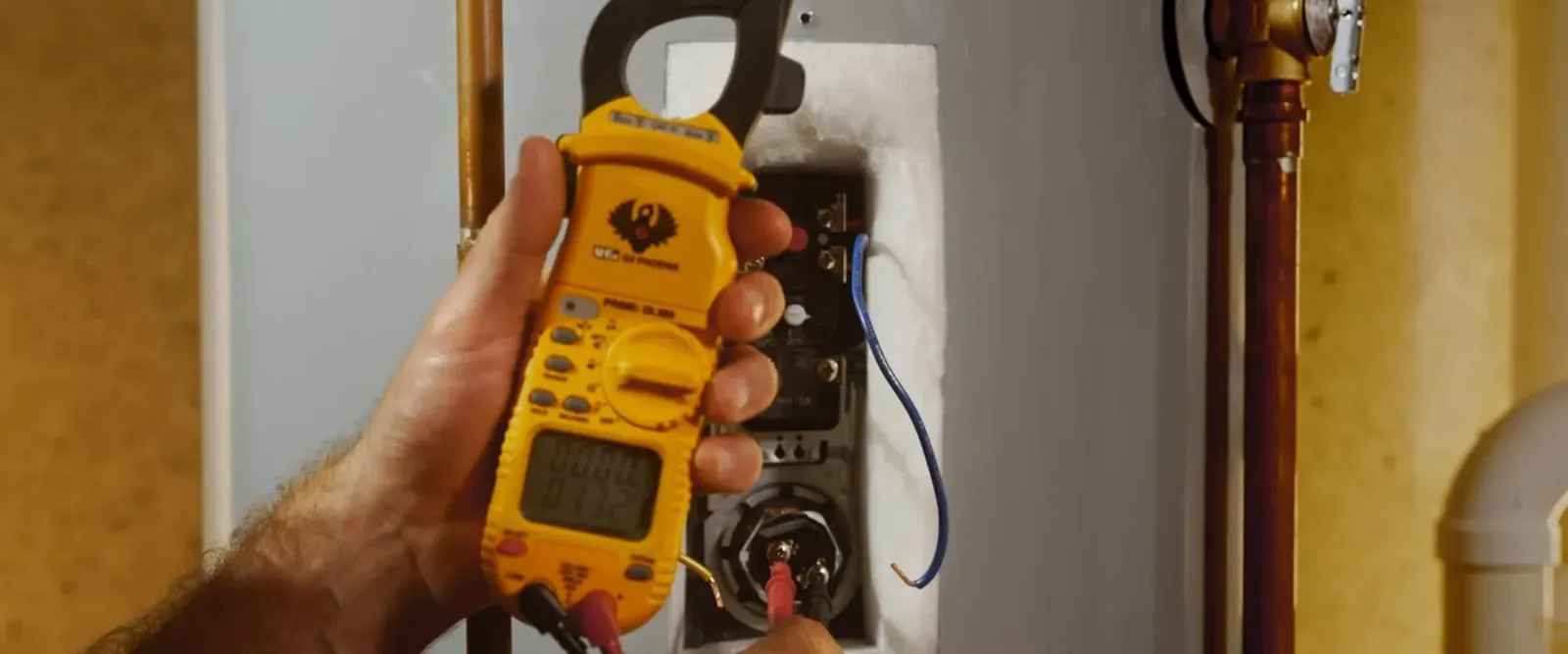
Signs a heating element has failed
| Symptom | Likely cause | What to do |
|---|---|---|
| No hot water at all | Upper element, thermostat, tripped breaker, or tripped high-limit reset | Check the breaker first, then call if it trips again |
| Hot water runs out quickly | Lower element failed | Have both elements and thermostats tested |
| Lukewarm water | One element or a thermostat fault | Test with a meter or call |
| Breaker trips right away | Shorted element or wiring fault | Leave the breaker off and call |
| Water leaks from the tank | Tank corrosion, not an element | Turn off power and water, then call |
Elements wear out from heat and mineral scale. Sediment around the lower element makes it work harder and run hotter. Tanks that rumble or pop are warning you about buildup.
A tripped breaker and a reset button on the upper thermostat are the free checks. If either trips again after you reset it, something is shorted, and it needs a trained eye.
Safety before anything else
Electricity and water do not mix
Turn off the breaker for the water heater at the panel. Then remove the access panel and test the terminals with a non-contact tester and a multimeter. If you do not own a meter or you are unsure how to use it, call a licensed plumber. Never work on a heater you think might be live.
Do not proceed unless every item is true
- The breaker is off and labelled so no one turns it back on.
- A meter shows zero volts across the element terminals.
- The water supply to the heater is closed.
- The tank is drained below the element you are changing.
- You are standing on a dry surface with dry hands.
- You have the element wattage and voltage from the heater's rating plate.
Never energize an element that is not fully submerged. A dry element overheats in seconds and burns out. Never turn the breaker back on until the tank is completely full and air has been bled from a hot tap.
What you need
Replacement element
Match the voltage, wattage, and mounting style on the rating plate. Screw-in and bolt-flange types are not interchangeable.
Element wrench
A socket made for the job. A regular wrench slips and damages the threads.
Meter and tester
A multimeter confirms there is no power. It also tests the old element for continuity.
Hose and bucket
A garden hose to drain the tank to a floor drain or outdoors, plus a bucket and towels.
The steps in order
Cut power and test
With the breaker off, the plumber removes the access cover and insulation and checks the terminals with a meter to confirm they are dead. If you cannot confirm zero volts, stop and call. The wiring gets photographed before anything is disconnected.
Close the water and drain the tank
Shut the cold supply valve, open a hot tap upstairs to let air in, and drain the tank below the element through the drain valve.
Disconnect and remove the old element
Only after the terminals read dead are the wires taken off. Then an element wrench turns the element counterclockwise and it lifts out with its gasket.
Install the new element
Clean the opening, fit the new gasket, hand-thread the element straight, and tighten with the wrench. Do not overtighten.
Refill, check, and restore power
Close the drain, open the cold valve, and leave the hot tap running until water flows steadily. Check for leaks, replace the cover, and only then switch the breaker on.
Do it yourself or call a plumber
Consider calling a licensed plumber when
- You do not own or know how to use a meter
- The element will not unscrew or the threads are damaged
- The tank is old, leaking, or heavy with sediment
- The breaker or reset keeps tripping
- You want a thermostat or wiring tested too
Replace the whole heater when
- The tank is leaking from the shell
- The unit is near the end of its life
- Several parts have already failed
- Sediment has built up so heavily that the tank is ruined
Our water heater repair team tests elements and thermostats with a meter and can swap them the same day when available. If the tank is the problem, water heater replacement is the better call. We also take these calls from Dracut and North Andover.
Wattage and voltage must match the rating plate on your tank, according to the maker's guidelines. Past a breaker-off swap, live power and a pressurized tank mean this is a job for a licensed plumber, with an electrician for any wiring.
Cost factors for an element repair
What changes the price
The element is a low-cost part, so most of the price is the diagnosis and labor. Heavy sediment can add draining and flushing time.
Other factors include tank size and age, whether both elements or thermostats need work, how easy the heater is to reach, and the hour of the call. Call (603) 815-9179 and a licensed plumber will give you a clear price before work starts.
Licensed work and permits in Methuen
In Massachusetts, plumbing work is done by licensed plumbers, and permits are issued to licensed plumbers. Minor repairs are exempt under state rules. The 2022 Methuen fee schedule listed a $50 line for a water heater, which applies to replacing a unit. An element swap is generally minor, but ask the Inspections Division at 978-983-8625 if you are unsure.
Practical consequence: if the job turns into a tank replacement, a licensed plumber pulls the permit and the work is inspected. Check current fees, because the schedule is from 2022. You can verify a plumber's licence on mass.gov.
Source type: mass.gov plumbing board and 248 CMR 3.05, Methuen Inspections Division 2022 fee schedule.
Questions we hear
No hot water usually points to the upper one. Short hot showers usually point to the lower one. A meter test on each element gives the real answer.
Yes, if only one has failed. Many plumbers replace both if the heater is several years old and sediment is heavy, since the second is likely to follow.
An element that is not covered by water overheats and burns out quickly. Always bleed air from a hot tap until water flows before switching the breaker on.
It is generally a minor repair, which state rules exempt. Replacing a water heater has a permit fee line on the 2022 schedule. Ask the Inspections Division at 978-983-8625 if you are unsure.
This guide is for electric heaters only. Gas water heater work involves gas piping and venting, which is licensed work in Massachusetts, so call a licensed plumber.
Yes. Scale insulates the lower element and makes it run hot. Flushing the tank on a regular schedule, as the manufacturer advises, helps.
Not sure which case fits yours? Call (603) 815-9179 and describe what you see.