
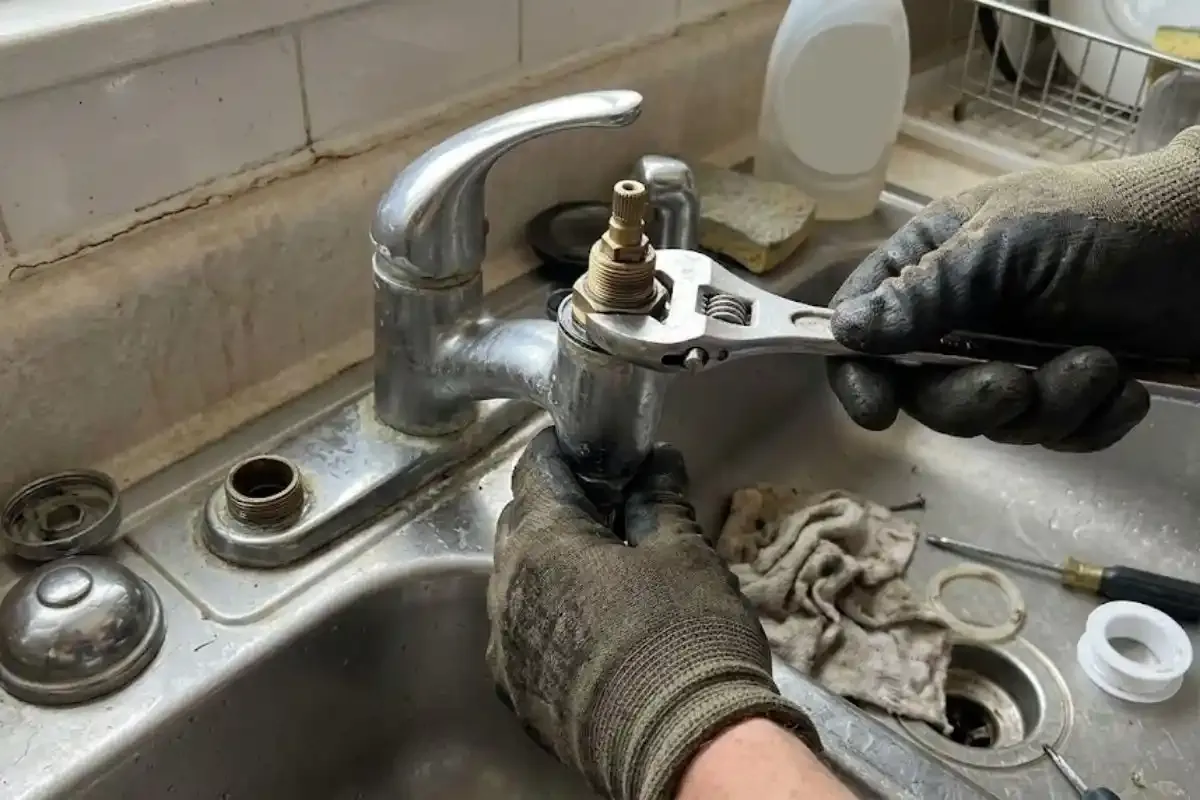
Start by naming the faucet you have
The fix depends on the faucet's guts, and bathroom sinks tend to come in four designs. Look at the handles and pull one off if you have to. You will recognize the type in under a minute.
| Faucet type | How to spot it | Usual culprit | Typical leak |
|---|---|---|---|
| Compression (two handle) | Handles turn several times to shut off | Rubber washer or worn seat | Drip from the spout |
| Cartridge (single or two handle) | Smooth lever or handle, retaining clip or nut | Cartridge or its O-rings | Spout drip or a wet base |
| Ceramic disc | Single lever on a wide cylinder | Seals or the disc cylinder | Spout drip, stiff lever |
| Older ball-style | Rare in bathrooms, rounded cap over a ball | Springs and seats | Leak at the handle |
Gather tools and shut the water off
Tools and supplies
Most of this is already in a drawer.
- Adjustable wrench and slip-joint pliers
- Phillips and flat screwdrivers
- Hex key set for set-screw handles
- Penetrating oil and a rag for stuck nuts
- Replacement washers, O-rings or cartridge (bring the old part to match it)
- Plumber's grease for rubber seals
- A towel or washcloth to plug the drain
Shut it off first, then confirm
Turn each small oval-handled stop valve under the sink clockwise until snug. Open the faucet to bleed pressure and check that the flow stops. If a stop valve will not turn or keeps leaking, do not force it. Close the house main instead and call a plumber.
Put a towel in the basin and cover the drain. A tiny screw or retaining clip falls into a drain faster than you can catch it.
Repairing the drip, step by step
Remove the handle
Pop off the decorative cap with a small flat screwdriver. Back out the screw or loosen the set screw with a hex key. Wiggle the handle up and off.
Pull the cartridge or stem
Unscrew the packing nut or retaining clip. For compression faucets, the stem unthreads. For cartridge faucets, pull the cartridge straight up, noting how it faces so the new one goes in the same way.
Inspect the rubber
Look at the washer, seat and O-rings. Flattened, split or hardened rubber is your answer. A gritty, scratched seat can be dressed with a seat tool, or the whole faucet may be worn out.
Replace and lubricate
Fit the new washer or O-rings, add a thin film of plumber's grease and reinstall the part. Do not overtighten a retaining nut, since brass threads strip quickly.
Reassemble and test slowly
Open the faucet handle, turn the stop valves back on a quarter turn at a time and check for drips at the base and under the sink. Let the water run for a minute to flush debris.
Stuck handle or won't shut off?
A seized handle or a stop valve that spins freely is a sign to stop. Call (603) 815-9179 and we can schedule a same-day visit when available.
Which part to blame, by symptom
Drip from the spout after shutoff
The washer, seat or cartridge is no longer sealing. This is the most common repair.
Water at the base of the handle
The O-rings on the stem or cartridge have worn. Replace them as a set.
Water around the faucet base on the deck
A deck gasket or the mounting hardware has loosened, or a supply line is seeping below. Dry it and watch where it returns.
Handle is stiff or sticky
Mineral buildup or dried grease inside the cartridge. A cleaning and fresh grease may be enough.
If the wet spot keeps returning and you cannot tell if it is the faucet or the supply, we can trace it with our leak detection equipment before anyone cuts into a vanity or wall.
DIY or call a plumber
Good DIY candidates
- A steady drip from one spout
- A leak around one handle
- A single washer, O-ring or cartridge swap
- Faucets less than two decades old with parts still sold
Better left to a licensed plumber
- Corroded or crumbling shutoff valves
- A faucet that needs to be replaced and re-fitted
- Leaks inside the vanity or the wall
- Discolored or pitted brass that will not seal again
If you decide the whole faucet is the problem, our faucet repair team can fix or replace it and test every connection. Small repairs on a leaky faucet generally do not require a permit in Massachusetts, but a licensed plumber should handle anything involving new piping.
Cartridge and seat kits are made to each brand's own standards, so match the number on the manufacturer's parts sheet before you buy. New piping is covered by 248 CMR, which is why that stays with a licensed plumber.
What not to do
- Do not crank on a handle that will not turn. Brass and chrome break.
- Do not use plumber's tape on a faucet cartridge. It is for threaded pipe joints.
- Do not force a rounded nut with locking pliers over and over. Use penetrating oil and give it time.
- Do not leave the supply on while you disassemble anything.
- Do not ignore a drip you have already had for months. The seat wears faster the longer it leaks.
What affects the price
The part
Washers and O-rings are cheap and quick. A full cartridge or a sink faucet replacement costs more.
Access
A pedestal sink, narrow vanity or corroded handle slows the work.
Shutoff valve condition
Failed stop valves add a valve replacement to the job.
Faucet age and availability
Discontinued models may need a replacement faucet rather than a rebuild.
We give a clear price before work starts, so call (603) 815-9179 for one that fits your sink.
Methuen's river water and your bathroom faucet
Methuen's water comes solely from the Merrimack River, treated at a single plant with alum, carbon filtration, pH adjustment and a blended phosphate corrosion inhibitor. The corrosion inhibitor is there to help protect pipes and fixtures from the water itself.
How much mineral scale builds up inside your faucet depends on your tap and your pipes, and it varies. The city's report does not give a hardness figure we can cite. Look for white crust on the aerator and stiff handles. Then ask the Methuen Water Department for its annual water quality report, or test your tap with a simple home kit.
Homes built before 1940 may still have older plumbing. If your faucet repair exposes old galvanized or lead-looking lines, stop and have a licensed plumber look. The city publishes a service line inventory map you can check.
Source type: Methuen water quality report (CCR) and city service line inventory.
Questions we hear
Turn off the stop valves, take the handle apart, and replace the worn washer, O-rings or cartridge. Match the new parts to the old ones.
The seal inside is worn or there is scale on the seat. Replace the washer, seat or cartridge, and the drip usually stops.
Not if the stop valves under the sink work. Close them and open the faucet to confirm. If they fail, close the house main.
When parts are hard to find, the finish is pitted, or the leak keeps coming back. Our plumbers will tell you plainly if a rebuild will not last.
Methuen blends a phosphate corrosion inhibitor to protect pipes. Scale and mineral buildup still vary from tap to tap, so inspect your aerator and ask the Water Department for its annual report.
Not sure which case fits yours? Call (603) 815-9179 and describe what you see.