
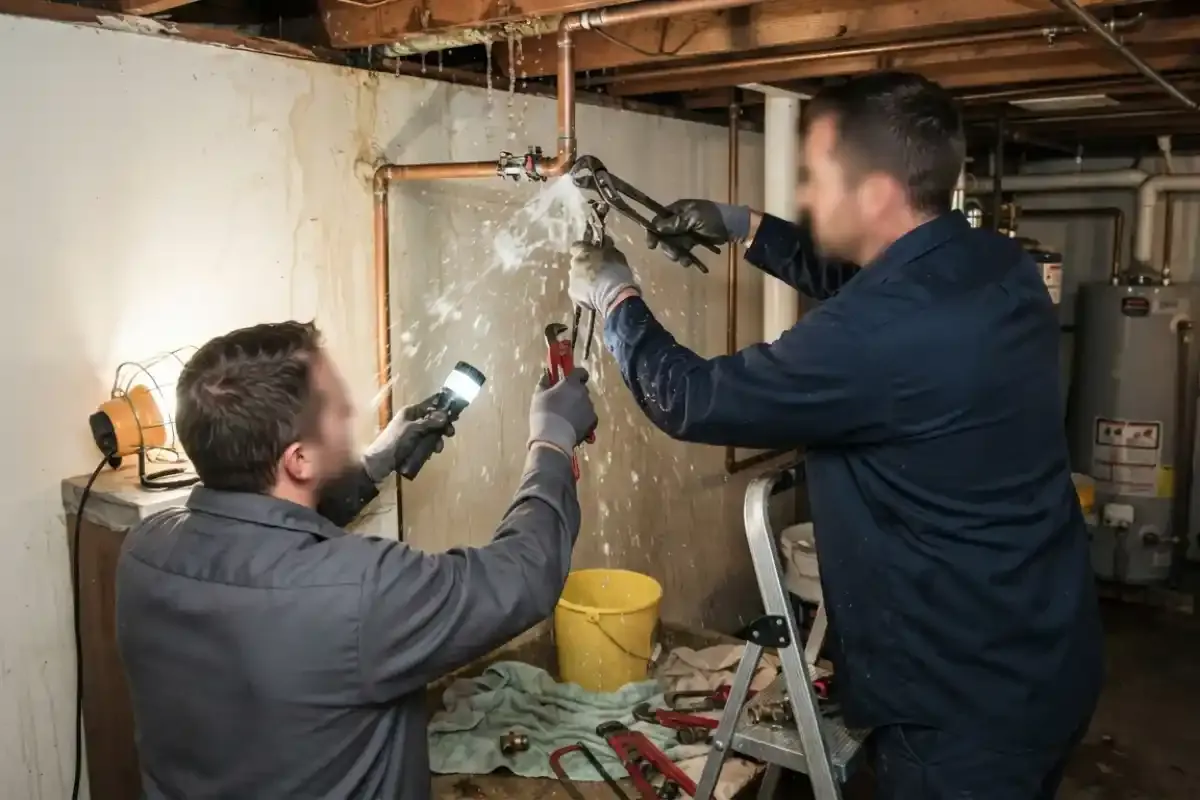
Minute by minute: the first hour
Shut off the main
Find the main shutoff where the water line enters the house, often in a basement or utility room. Turn it clockwise until it stops. If it will not turn or the break is outside, skip to the street shutoff note below.
Drain the lines
Open the lowest cold faucet and the highest one, and flush a toilet. This relieves pressure and drains water from the broken section.
Cut power near the water
If water reaches outlets, appliances or the panel, turn off the breaker for that area from a dry spot. If you must stand in water to reach the panel, do not. Call the utility or 911.
Save what you can
Lift rugs, move electronics and papers up, and set buckets. Do not reach into sagging ceilings, which may be holding a lot of water.
Call a plumber and document
Call (603) 815-9179 for 24/7 dispatch. While you wait, take photos and video of the break, the water, and everything damaged.
Warning: electricity and water
Never touch a wet outlet, cord or appliance. Do not use a wet vacuum in standing water that may be near live wiring.
Temporary repair or permanent fix
Emergency plumbers usually stop the leak first, then plan the lasting repair. Which one you need depends on the pipe, the break and the conditions.
| Approach | What it does | Limits |
|---|---|---|
| Shutoff and drain | Stops water at the source | Only a pause, the pipe is still broken |
| Clamp or push-fit coupling | Seals a short, clean break | May not suit corroded or split pipe |
| Cutting out and replacing a section | Restores a permanent run | Needs access and, where required, a permit |
| Replacing a longer run | Fixes pipe that is failing in several spots | Higher scope, more opening of walls |
If the failure came from freezing, the pipe near the break may be damaged beyond the visible split. A plumber checks a few feet either way before closing the wall.
Under 248 CMR 3.05, according to mass.gov, permits go to licensed plumbers, minor repairs are exempt, and emergency work must be inspected by the next working day. Ask your plumber which category your repair falls into.
Water still running?
Call (603) 815-9179 now. Tell the dispatcher where the water is, what you shut off, and whether power is affected.
Damage control for the next 48 hours
Wet drywall, insulation and flooring hold moisture and can grow mold fast. Open windows if the weather allows, run fans, and remove soaked carpet pad. Ask a drying contractor before you throw out anything you might need for a claim.
Water-damaged ceilings
Stay out from under a bulging ceiling, keep people away, and tell the plumber when you call. Do not poke it.
Wet insulation
It stays wet for days and hides corrosion. A plumber and a drying crew will decide what must come out.
Standing water in a basement
Pumps can clear it, but not until power is confirmed off. See sump pump repair if your pump failed.
Records for your insurance claim
Keep these items
- Photos and video taken before cleanup begins
- The plumber's written description of the cause and the repair
- Receipts for emergency repairs, drying and hotel stays
- A list of damaged belongings with age and approximate value
- Names, dates and times of every call to your insurer
Coverage depends on your policy, and some policies treat sudden bursts differently from slow leaks. Ask your insurer before work starts what documentation they need, and do not sign a repair authorization until you have read it.
DIY or call a plumber
You can do
- Shut off the main and drain the lines
- Turn off a breaker from a dry spot
- Move belongings and start towel removal
- Photograph the scene
Leave to a licensed plumber
- Cutting out and replacing pipe
- Soldering or press fitting a repair
- Opening walls to trace the break
- Anything involving the gas line or water heater
Do not solder or use a torch near wet framing. Water and flame in a wall is a fire risk, and pipe joints made without the right prep tend to fail again.
What shapes the repair bill
- How easy the pipe is to reach, and how much wall must be opened
- Pipe material and how long the damaged run is
- Whether the break is one spot or several
- Whether a permit and inspection are part of the work
- The after-hours timing of the call, and any drying work
Call (603) 815-9179 for a clear price before work starts. Our burst pipe repair team can also trace hidden leaks using leak detection. We dispatch to Dracut and Lawrence as well.
Methuen shutoffs, frost depth and emergency permits
If the problem is at the street, such as a curb stop you cannot reach or a main problem, the Methuen Water Department runs a 24-hour water emergency line at 978-983-8855. Call it to arrange a street shutoff when your own valve will not close.
The statewide residential code table uses a 48 inch frost depth for design. Buried lines are meant to sit below that, but pipes in exterior walls, garages and crawl spaces are above it, which is where winter bursts usually start.
Under Massachusetts rules (248 CMR 3.05), emergency temporary work is allowed when the inspector is notified, and the work must be inspected by the next working day. Your plumber handles that notice, so ask about it.
Source type: Methuen DPW, state building code table, mass.gov plumbing code.
Questions we hear
Yes, if you can reach the control safely. Turn off the electric breaker or set a gas unit to its off or pilot position, so it does not heat an empty tank.
A full-bore break can put a lot of water into a house quickly. Shut the main first, then investigate.
It depends on your policy. Sudden bursts are often treated differently from slow leaks, so read the policy and call your insurer early.
You can shut off the water and drain the lines. The repair itself needs a licensed plumber, especially when soldering or a permit is involved.
Do not force it with a wrench. In Methuen, call the 24-hour water emergency line at 978-983-8855 for a street shutoff, then call a plumber to replace the valve.
Yes. Under state rules emergency temporary work must be inspected by the next working day, and a licensed plumber handles the notice.
Not sure which case fits yours? Call (603) 815-9179 and describe what you see.