
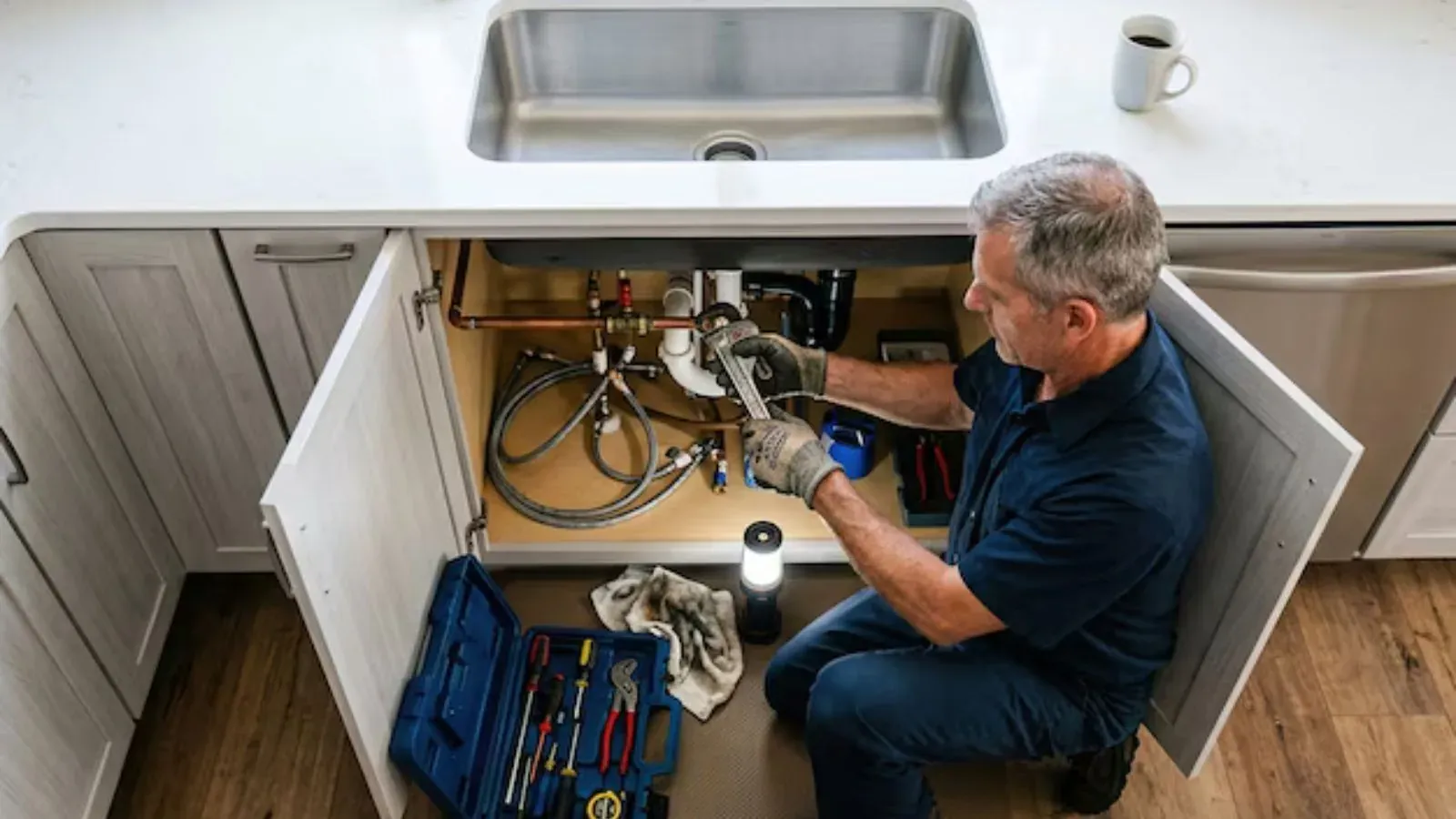
Meet the parts under your sink
| Part | Where it is | What it does | How it fails |
|---|---|---|---|
| Stop valves | On the wall or floor below the faucet | Shut off hot and cold to that sink | Seize, weep at the stem, drip at the connection |
| Supply lines | Between stop valves and faucet | Carry water to the faucet | Kink, corrode, burst at old ends |
| Pop-up drain and stopper | In the basin bottom | Opens and closes the drain | Hair buildup, loose lift rod, leaking nut |
| Tailpiece | Straight pipe below the basin | Connects drain to trap | Cracked washer, loose nut |
| P-trap | U-bend below the tailpiece | Holds water to seal out sewer gas | Clogged with hair and soap, leaking nuts |
| Trap arm | From trap to wall | Sends waste into the drain line | Sags, wrong slope, slow drain |
Knowing the names helps you buy the right parts and describe the problem when you call. It also keeps you from loosening the wrong nut and flooding the vanity.
Clean a P-trap and clear a slow drain
Set up
Empty the vanity. Put a bucket and a towel under the trap. Do not run the water while the trap is off.
Loosen the slip nuts
Turn the two big nuts by hand if you can. Use channel-lock pliers wrapped in a rag for stubborn ones. Plastic traps need only gentle force.
Empty and clear
Tip the trap into the bucket. Pull out the hair and soap wad with a bent wire or an old brush. Rinse it in a utility sink.
Check the washers
The tapered washer inside each nut must face the right way, with the thin edge toward the joint. Replace any washer that looks flat or cracked.
Reassemble and test
Hand-tighten, then a gentle quarter turn with pliers. Fill the basin, pull the stopper and check for drips with a dry tissue.
Skip the chemical drain cleaner
Caustic liquids sit in the trap, soften plastic and splash on skin when you open it later. A plastic drain claw or a hand auger does the job without the risk.
Stop valves and supply lines
Valve won't turn
Years of unused time lock the stem. Try gentle pressure only. If the stem spins freely or leaks, stop and call a plumber, because forcing it can start a leak you cannot shut.
Drip from the valve stem
A packing nut a quarter turn tighter often stops it. If not, the valve needs replacing.
Braided supply line
Replace every braided line when you replace a faucet. Look for rust on the nuts, bulging sleeves or kinks.
Hot and cold mixed up
The left side is conventionally hot. If the faucet works backward, check that the supply lines are on the right valves.
When a stop valve fails completely, the sink repair turns into a plumbing job. Our faucet repair visits cover the valves and lines that sit under the faucet along with the faucet itself.
Valve stuck and water still running?
Close the main water shutoff near your meter and call (603) 815-9179. We schedule same-day visits when available.
The pop-up drain and stopper
The pop-up assembly links a vertical lift rod behind the faucet to a pivot rod that moves the stopper. When the sink drains slowly with the stopper in, the pivot may sit too low or hair may coat the stopper.
Lift the stopper
Many stoppers lift straight out. Some twist, or release when you unscrew the pivot rod nut at the back of the tailpiece.
Clean the rod and the stopper
Wipe away hair and slime. Replace a worn rubber seal on the pivot rod.
Reset the linkage
Adjust the clevis strap so the stopper lifts about a quarter inch when the lift rod is up.
If the nut at the base of the tailpiece drips, the gasket underneath is worn. Unscrew, replace the gasket and reseal, with or without plumber's putty depending on the maker's instructions.
What a slow drain is really telling you
Likely a local clog
- Only this sink drains slowly
- Water gurgles in the sink, not elsewhere
- Hair or soap is visible at the stopper
- Cleaning the trap restores flow
Likely deeper in the line
- The tub or toilet also gurgles
- Cleaning the trap changes nothing
- The slow drain returns within days
- There is a smell of sewer gas
A line-wide problem calls for a cable, not a trap cleaning. Our drain cleaning crews run cables and cameras through bathroom branch lines and the main when the clog is beyond reach.
DIY, call a plumber, or stop
Call a licensed plumber for
- Any change to the location of the sink or its drain
- A drain or vent pipe inside the wall
- Corroded or lead-looking supply pipe
- Gas piping of any kind (this is licensed work in Massachusetts)
- A leak you cannot trace after drying the cabinet
- Mold or soft vanity flooring
Everything above the stop valves and below the basin that you can reach is fair game for a careful homeowner. Past the wall, call a licensed plumber.
Follow the instructions packed with any new trap kit, stop valve or supply line, because fitting standards differ by brand. Piping behind the wall falls under the state plumbing code (248 CMR), so new work there goes to a licensed plumber.
What affects the price
Scope
Cleaning a trap, replacing a valve and re-plumbing a vanity are three very different jobs.
Pipe material
Chrome brass, PVC, galvanized and copper each need different parts and fittings.
Access
A pedestal sink or a tight vanity makes the work slower.
Parts
Brand-name valves, stoppers and lines cost more than generic ones.
We give a clear price before work starts. Call (603) 815-9179 and describe the sink.
Licensed work and permits in Methuen
Under Massachusetts rules, only a plumber licensed by the Board of State Examiners of Plumbers and Gas Fitters may do plumbing work, and permits are issued only to licensed plumbers. Minor repairs, such as fixing a leaky faucet, do not need a permit. Replacing a P-trap or a supply line is generally minor, but moving a drain or adding a fixture is not, so ask the Inspections Division.
Methuen's Inspections Division at 41 Pleasant Street, Suite 203, issues plumbing permits and can be reached at 978-983-8625. Emergency repairs may proceed, but the inspector must be notified and the work inspected by the next working day. The 2022 fee schedule listed a $50 minimum and $5 per fixture. Check the current schedule.
Homeowners can verify a plumber's license on mass.gov. The license type and number must appear on the plumber's advertising, so ask before you hire.
Source type: mass.gov plumbers and gas fitters consumer fact sheet, 248 CMR 3.05, and Methuen Inspections Division fee schedule.
Questions we hear
It is the U-shaped pipe under the sink. It holds a plug of water that stops sewer gas from entering your home, and it catches heavy debris.
Hand tight, then a gentle quarter turn. Plastic washers seal by compression, and overtightening cracks them.
Hair and soap on the stopper and in the trap are the usual cause. If the tub and toilet also drain slowly, the clog is deeper.
Massachusetts exempts minor repairs from permits. Moving or adding plumbing needs a permit, and permits are issued to licensed plumbers.
Yes. Massachusetts lets homeowners verify a license on mass.gov, and the license type and number must appear on advertising.
Not sure which case fits yours? Call (603) 815-9179 and describe what you see.